


The Scottish Comics Roundtable Report
0. Introduction & statistics
This is an overview of the presentation and discussions from the Scottish Comics Roundtable, which took place on 9th September 2026. This online roundtable was part of the UK Comics Creators Research Project, which is a collaboration between the Comics Cultural Impact Collective, the Society of Authors, and the Association of Illustrators, funded by Arts Council England and Arts University Bournemouth. The roundtable was organised in collaboration with Small Press Scotland CIC, with assistance from CHIP Collective.
The meeting lasted two hours, with two breakout room sessions. Attendees could choose which topic they were most interested in discussing for each session. After 20 minutes, all attendees would return to the main room for a recap. The topics were:
- Festivals & event planning
- Comics education & training
- Comics used for education / applied comics
- Earning an income
- Funding
- Breaking into comics
- Retailers
- Printing & production
Breakout rooms were helmed by Eve Greenwood, Faye Stacey, Ashling Larkin, Cat Laird, Chris Lau Manson, and Edward Ross, with Hannah Berry leading and Maria Stoian as tech. Peter Morey was also taking part as a visual scriber. At the peak of the discussion, excluding moderators/organisers, we had 61 attendees.
While Scotland has 8% of the UK’s population, it has 15% of the UK’s comic creators. 3/4 of Scotland’s comic creators live in the central belt. Before the discussion, Hannah Berry presented statistics on how Scotland’s comic creators compare to the average comic creators across the whole of the UK*:
* This data is based on self-reported postcodes in the UK Comic Creator 2026 Report and comes from a relatively low sample size, as not every respondent provided their postcode. These numbers should be considered an estimate only, and more research is needed to solidify accurate figures.
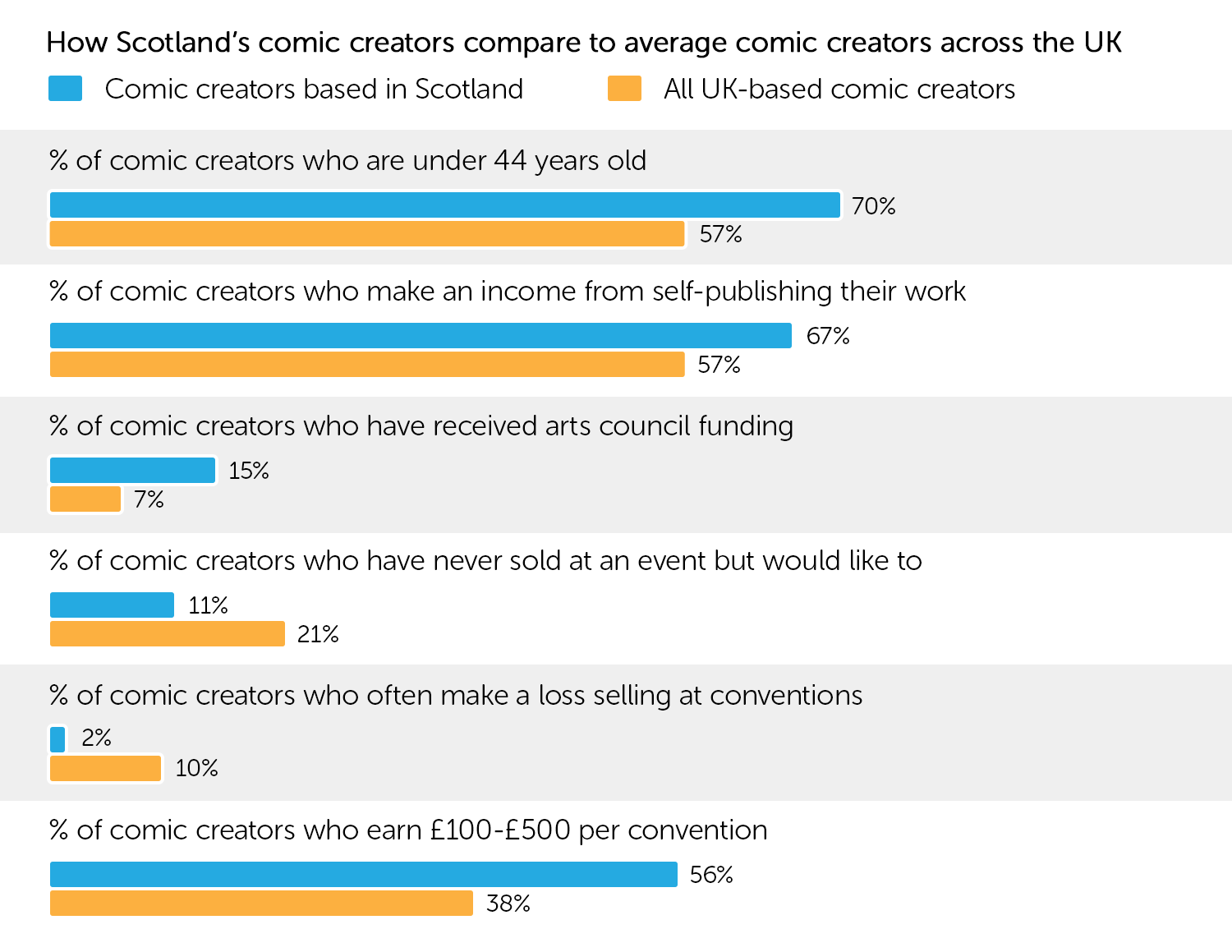
Despite these encouraging figures, some of the key challenges faced by comic creators across the UK seem to impact Scotland’s comic creators at a higher rate:
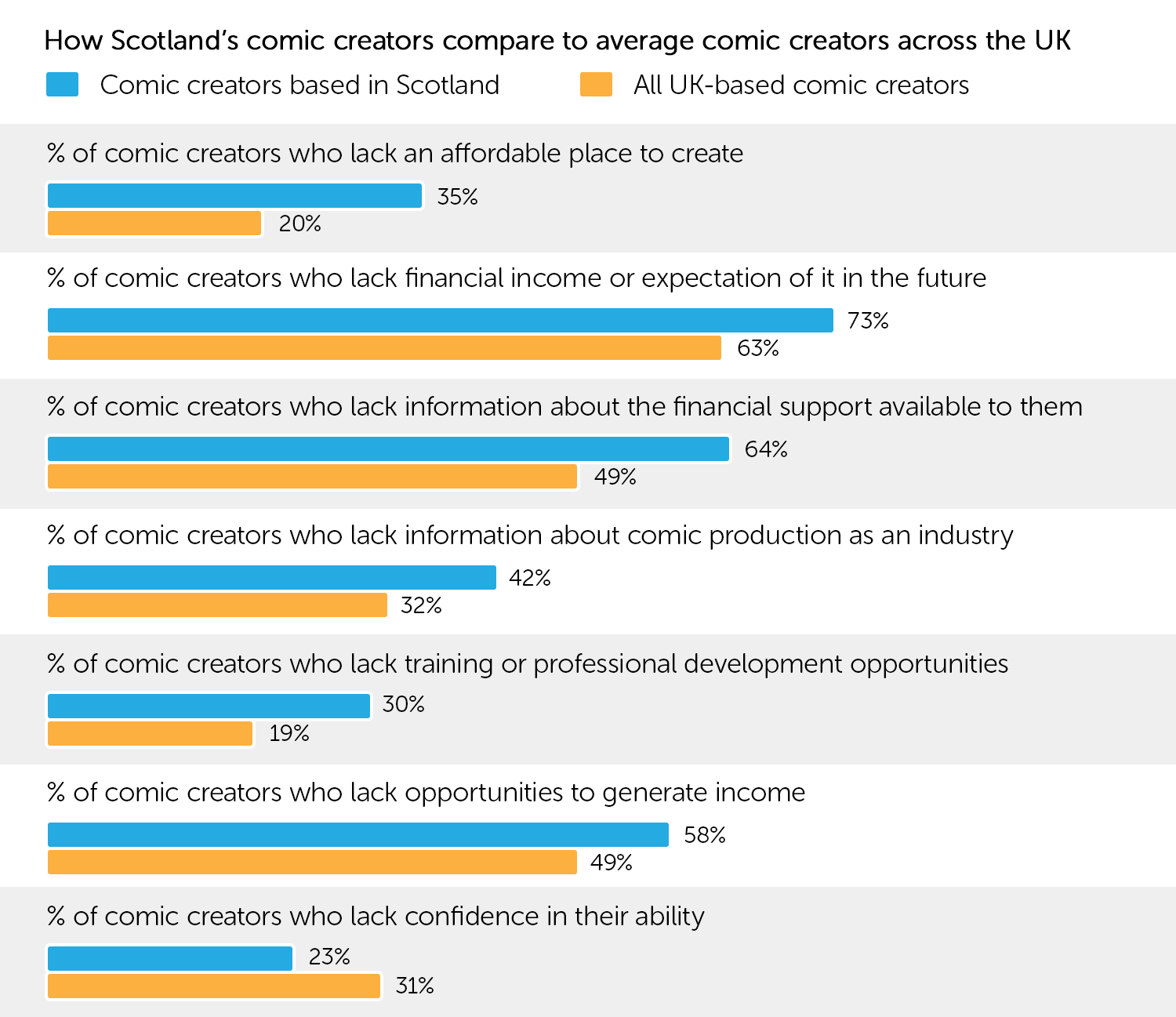
This suggests a potential trend: Scotland’s comic creators are passionate and confident about their work, and we have an eager audience who is willing to spend on them. Scotland’s comic creators are, on average, more confident in their ability compared to the average UK comic creator. However, this could also be an indication of the kinds of people who are able to work in comics in Scotland. Creators living outside the central belt may have fewer opportunities to meet colleagues, develop their craft, and sell at events, and so the data may be skewed in favour of more central creators, who have a larger local network and more opportunities. Either way, it is also clear that Scotland’s creators are generally at a disadvantage compared to their peers across the UK, with a more consistent lack of opportunities, information, and financial security.
So let’s fix it! The rest of this report outlines the problems that were raised, and potential solutions suggested for each problem. If there’s a solution in this report that you think you can make happen, we encourage you to do so!
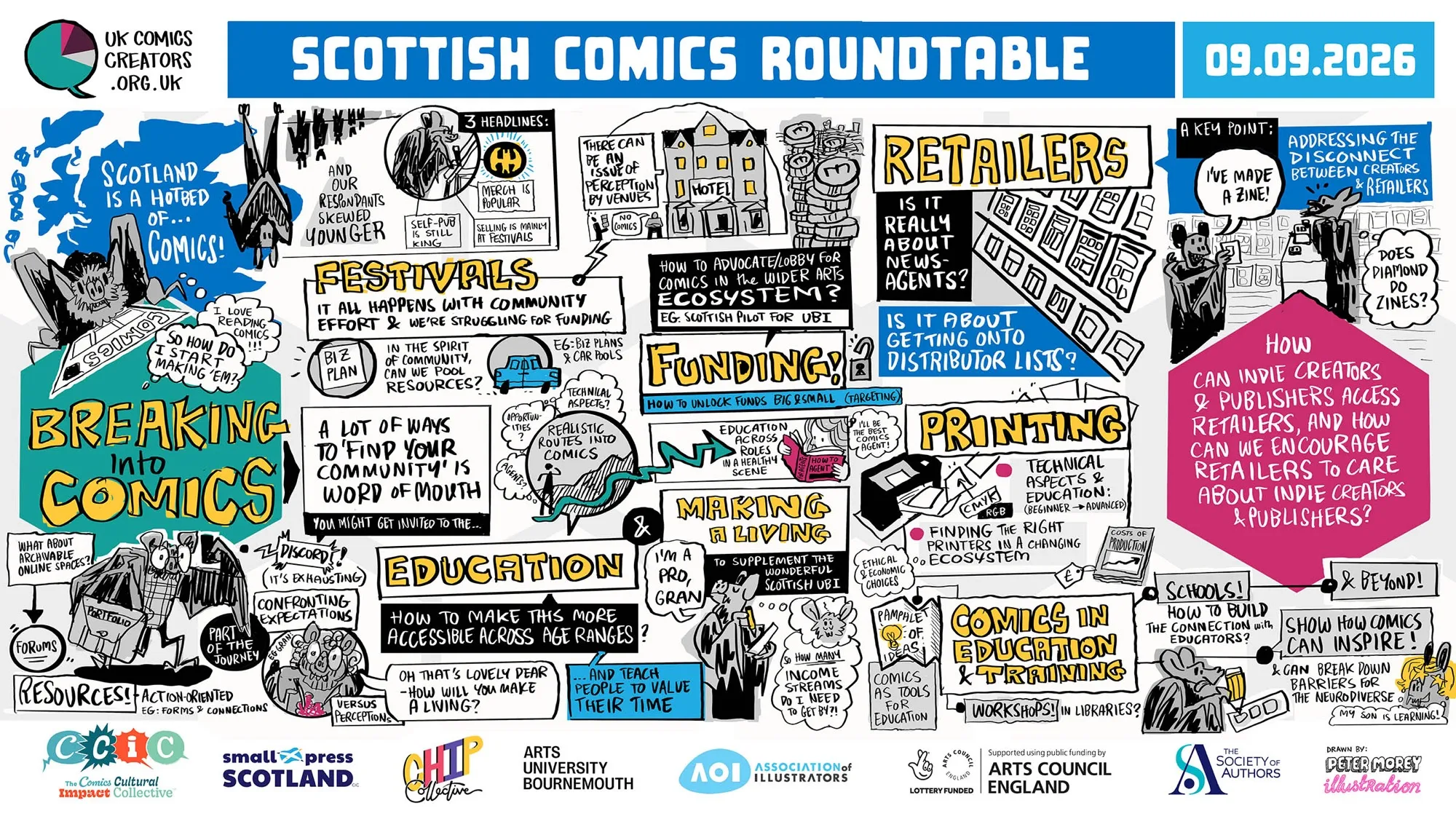
Click on the image to see it at fullsize.
The links in the "suggested resources" sections were shared by attendees of the roundtable and their inclusion here is not necessarily an endorsement by Small Press Scotland.
1. Festivals & event planning
Problem: People who want to run new events have very little information on how to do so, or on their legal obligations, unless they have had prior event experience.
Potential solutions:
- Create an environment where new organisers feel comfortable reaching out to established event organisers to ask for feedback or advice.
- Create publicly available business plan templates and checklists for new event organisers.
- Create resources outlining insurance, legal obligations, market licences, etc.
Suggested resources:
- Cymera Festival is happy to share their business plan with new events
- Small Press Scotland provides yearly reports with breakdowns of how its events are organised
—
Problem: Event organisers and attendees alike find it difficult to get an overview of all the comic and literature events taking place in Scotland.
Potential solutions:
- Create a comic event calendar.
- Create a newsletter akin to Luke Surl’s ComicTablesUK mailing list (now defunct) to alert people when table applications open or when an event is coming up.
- Reach out to existing event calendars to add comic events or request opening to comic events.
Suggested resources:
- Literature Alliance Scotland’s book festival calendar
- DowntheTubes British and Irish comics event calendar
—
Problem: The majority of Scotland’s comic events take place in the central belt, between Edinburgh and Glasgow, so creators in the Borders or the Highlands are often excluded or have to travel a significant distance in order to access the same events as their peers.
Potential solutions:
- Reach out to creators outside the central belt to connect them with their peers and make sure they are involved and know about events and meetups.
- Put forward more travel grants.
- Arrange buses or cars to pick up exhibitors to ease travel costs.
- Arrange discount or subsidised hotel rooms.
- Arrange transport sponsorships to support travel grants or hotel rooms, in exchange for the event encouraging attendees to travel by public transport.
- Eg. Scotrail, Stagecoach, Ember
—
Problem: We need to increase the number of local opportunities available to creators outside the central belt, and to encourage creators from the central belt to attend those events.
Potential solutions:
- Seek funding from local councils, especially those geared towards book and literature events.
Suggested resources:
—
Problem: Smaller event organisers are forced to spend money from their own pockets when they don’t receive funding.
Potential solutions:
- Create a list of event-specific funding outside of Creative Scotland so less events are reliant on an unstable funding source.
Suggested resources:
- VisitScotland has an event fund between £5,000 and £25,000 if you’re putting on a festival outside of Edinburgh or Glasgow
- Organisations can apply for £700 to put on an event as part of Book Week Scotland
—
Problem: Many Scottish creators have to travel to England for events, even smaller ones, but English creators only tend to travel up for major Scottish shows.
Potential solutions:
- In the same vein as LICAF receiving Creative Scotland money to support Scottish creators traveling south, Scottish festivals could seek Arts Council England funding (or alternate funding in England) to support English creators traveling north.
—
Problem: There is little overlap between comic and other literature events, opening opportunities for comic events to expand their programming and take lead from other industries’ events.
Potential solutions:
- Run comic readings.
- Run workshops on the mechanics of comics, eg. thumbnails, layout.
- Feature gallery spaces as part of events where attendees can read comics in large pages on the wall.
Suggested resources:
2. Comics education & training
Problem: We want to foster a love and appreciation for comics in children.
Potential solutions:
- Create an outline on how to approach schools or community centres to propose speaking about comics; going to where children already are, rather than trying to create brand new spaces.
- Pair young people with older folks to collaborate on comics.
- Set up writing and art classes and comic clubs.
Suggested resources:
- Comics Youth SCIO works with children and schools
- Magic Torch Comics CIC works in Inverclyde with schools and community groups helping kids create comics, as well as producing informational ones
- Super Power Agency is a literacy charity based aimed at helping young people in Scotland write their story.
—
Problem: Almost all comic education is geared towards children rather than adults, and especially adults who aren’t already interested in comics. This leaves few opportunities for adults over the age of 25 to learn more about comics.
Potential solutions:
- Develop learning that can continue into adulthood to prevent children losing their enthusiasm for comics.
- Develop classes that are not age-restricted.
- Run events in conjunction with established conventions where people can learn about illustrating or writing comics (for example, convention on Saturday, training on Sunday).
- Develop comic classes and talks for adults in care homes, or to be used in art therapy.
- Encourage people who may never have considered comics as a pathway before.
Suggested resources:
—
Problem: Creators may be at a disadvantage due to not having a formal arts education or not having the time or resources to develop their comic skills.
Potential solutions:
- Apply for funding for professional development or time spent working on a project, as other creators have found success with this in the past.
- Run paid residencies with the aim of encouraging people to develop their comic craft.
- Run workshops that cross-train with other industries, like printing basics.
- Counteract well-intended advice from other people regarding the value of comics as an art form and a career.
- Teach people to value their time and effort.
- Teach people to value their work and see it as a professional endeavour, not “just” a side gig.
—
Problem: Comic creators usually only speak to other comic creators rather than forging bonds with people working in other industries, and they tend to stick to pre-established, traditional methods for success. When creators are only able to learn from each other, they will eventually run up against a ceiling of knowledge.
Potential solutions:
- Make an effort to reach out to creators from other industries and tapping into external wells of knowledge and resources, particularly for more advanced information and printing techniques.
- Reach out to people working in academia and other communication areas to share the importance and strength of comics as a medium.
- Reach out to allies with technical knowledge to help develop systems that could support the comic community, such as developing newsletters, forums, websites, databases, etc.
- Invite publishers to attend workshops or meetings with independent creators to pass on vital knowledge about the industry.
—
Food for thought: There is a distinct lack of university-level support for comics, but while the academic study of comics lends a sense of legitimacy to the field, it also runs the risk of alienating grassroots and independent creators.
3. Comics used for education / applied comics
Problem: We want to foster a love and appreciation for comics in schools and educators.
Potential solutions:
- Establish agents to promote comics with schools and educate the educators on the benefits of comics.
- Align talks and workshops with established school curriculums.
- Propose using comics to help neurodiverse students engage with their studies and pass their exams, working with school disability officers/advisors to bridge that gap.
- Find funding first, and then approach schools to make it easier for schools who don’t have available funding to cover workshops or talks.
Suggested resources:
- “Unlocking the power of comics: why the multimodal format is a dynamic and vital part of literacy”, an article from the Literacy Trust
- Comics in the Classroom: Boosting Multiliteracies, Creativity and Collaboration Through Comics by Helen Jones and Lucy Starbuck Braidley
—
Problem: Creators feel that they are brought into schools to purely engage reluctant readers rather than all readers at all levels, and that comics are seen as a lesser literary medium.
Potential solutions:
- Campaign nationwide for the recognition of comics as an artform and form of literature.
Suggested resources:
—
Problem: AI is a potential threat to educational comics, especially as people working in fields like academia or science are encouraged to use AI in their workflows and may consider AI as a useful tool to visually convey ideas.
Potential solutions:
- Bridge the gap between the comic industry and informative fields like science in order to create a culture of comics being used to share vital information.
- Create a list of creators working in nonfiction or educational comics that can be shared with companies or educational bodies.
- Create resources to teach those working in academia or science about the failings of AI and train the unfamiliar eye on how an AI comic can be ineffective at visually conveying ideas.
4. Earning an income
Problem: Creators want a more arts-based income rather than splitting their focus between their work and an unrelated day job.
Potential solutions:
- Establish multiple income streams: commissions, talks, author visits, selling at events, selling online.
- Make connections with and working alongside comic-aligned industries like video games, tabletop games, and animation.
- Work with prose authors and creators from other industries to create minicomics to promote their work.
- Reach out to schools and libraries to offer author visits, including virtual visits.
- Apply for funding to cover a book tour.
- Lobby for the Scottish Government to implement an Artist’s Exemption similar to Ireland’s, allowing creators to keep more of their earnings.
- Ireland's Artists’ Exemption allows qualifying self-employed creators to earn up to €50,000 per year completely free of income tax on earnings from original artistic works.
Suggested resources:
- The Scottish Book Trust’s Live Literature programme provides funding for author events
- The Live Literature Author Directory (open to all creative practitioners working in literature)
—
Problem: Creators may have multiple income streams, but a single income stream should be feasible and possible to avoid the need to juggle multiple responsibilities.
Potential solutions:
- The implementation of the Scotland’s Basic Income for Artists scheme, which will launch in 2028.
- “The scheme would start with a pilot project to top up the incomes of up to 1,000 artists, musicians and designers to make sure they made a living wage, provided they had proof of other earnings or income.” - The Guardian
- The implementation of grants that go towards comic writers specifically.
Suggested resources:
- Basic Income for Artists Scotland, the campaigners behind the scheme
- Literature Alliance Scotland runs bursaries for works-in-progress
—
Problem: Creators are unsure of what goes into traditional publishing or the steps to securing a publishing deal.
Potential solutions:
- Create an environment where published creators are comfortable sharing the paths they took, what they were paid, and their work timelines/deadlines.
- Collating resources that outline how traditional publishing works.
Suggested resources:
—
Problem: More UK-based publishers are beginning to publish graphic novels but are paying too little, setting tight deadlines, asking too much for what they’re paying, or not paying on time. Un-agented creators are often unequipped to advocate for themselves and there are very few UK-based agents who are interested in graphic novels.
Potential solutions:
- There should be more literary agents with a background in comic creation who are familiar with comic production and can advocate for kinder deadlines and higher pay.
—
Problem: Creators are unsure how to seek an agent.
Suggested resources:
- #DVpit is a pitching event on Bluesky for marginalised creators to pitch their work to agents
- Comic Creator's Guide to Literary Agents by Danielle Chuatico & Jesncin Wibowo
- A Literary Agent’s Guide to Querying Your Graphic Novel by Maria Vicente
- Finding an Agent as a Graphic Novelist by Victoria Ying
- Why you should get an agent and how to present yourself to one: a primer for comics artists by Wendy Xu
—
Problem: Conventions are a major way creators earn money but are not a guarantee of profit.
Potential solutions:
- For events outside of Scotland that a lot of Scottish comic creators are attending:
- Create trails or maps to highlight those creators
- Connect with the event organisers to arrange a highlight page or post on social media
- Apply for Creative Scotland to fund pamphlets, announcements, or stamp rallies to highlight Scottish creators attending events.
- Establish travel networks (eg. couch surfing) to make it easier for creators to save money when traveling for events.
—
Problem: Online conventions were helpful for a lot of creators over the first few years of the pandemic and they continue to be helpful today, especially as a way to ease the pressure on creators needing to sell on predatory platforms like Etsy. Unfortunately, they are not as frequent as they used to be.
Potential solutions:
- Establish more online events.
- Seek other ways to relieve the burden of online selling platforms like Etsy or Ko-fi that have high transaction fees or limited/no search function
5. Funding
Problem: Creators have a lot of questions about funding - how it works, how their project fits into it, what points need to be made in the application, etc. Funding opportunities are sometimes unclear about whether a creator’s particular project would be eligible, particularly for personal projects or projects that are not community-oriented.
Potential solutions:
- Ask for better clarity for what counts as a fundable project.
- Invite representatives from Creative Scotland to attend comic events and answer questions about funding.
—
Problem: Funding bodies can differ on whether comics are classified as literature or a visual art; this is sometimes unclear and can result in failed applications even though comics straddle both fields. Some funding bodies have rules for the literature sector that don’t neatly apply to the comics medium, leading to applicants needing to adjust their application in order to fit within these guidelines.
Potential solutions:
- Work with funding bodies to create comic-specific application guidelines or sub-funds.
- Highlight to funding organisations that self-publishing has historically been the backbone of the comic scene, in contrast with other publishing industries, and that self-publishing is a valuable career path.
—
Problem: Creators find it difficult to communicate the value of self-publishing and how it differs from traditional publishing when applying for funding.
Potential solutions:
- Meet with Creative Scotland and other funding organisations to assess their knowledge of the comics industry and comics as a medium.
—
Problem: Funding opportunities like Creative Scotland’s Kickstarter Fund are useful, but there is no outline of the decision-making process and no feedback if your application is unsuccessful.
Potential solutions:
- Ask for better clarity on the internal workings of the Kickstarter Fund and similar funds.
Suggested resources:
—
Problem: Some creators have been funded for graphic novel projects in the past but have been refused funding for further comic projects because they already received funds for a similar project.
Potential solutions:
- Ask for better clarity on the guidelines around multiple projects working with the same medium.
—
Problem: Creators are generally unaware of alternate forms of funding other than Creative Scotland.
Potential solutions:
- Create a comprehensive list of funds available to Scotland’s independent comic creators.
Suggested resources:
—
Problem: The Basic Income for Artists scheme would be life-changing for Scotland’s artists, but we need to ensure comics are not sidelined or discounted as a meaningful art form.
Potential solutions:
- Lobby MSPs to make sure comic artists are represented in the pilot scheme.
- Prepare a template letter that Scotland’s comic creators could use to communicate with their MSPs.
- Prepare an open letter to the Scottish Government that Scotland’s comic creators could sign.
—
Food for thought: Should the community focus efforts on funding individual projects, vs funding wider organisational efforts to create support systems for the entire sector on Creative Scotland’s behalf? Larger infrastructure needs funding to help ease the burden on the individual creator and funding bodies in general, but individuals also deserve to have their projects funded directly.
6. Breaking into comics
Problem: It is difficult for new creators to make connections with their peers online, as many of these communities are not publicly accessible (eg. Discord servers) and creators may only know about them because of pre-existing friendships and connections.
Potential solutions:
- Create a forum for slower-paced, publicly accessible, and archivable conversation and resource gathering.
Suggested resources:
- Proboards, a free and customisable forum system
- The Comics Tree Discord server
- Zinemap
- “The Best of Scottish Comics” Bluesky starter pack by Steven Ingram
—
Problem: Even when creators have relationships with their peers, they still feel isolated due to the nature of comic creation, and there are very few in-person meetups outside of conventions and fairs where comic creators can meet with colleagues.
Potential solutions:
- Create a “conference season” over the winter months to reflect the “convention season” from spring to autumn, giving creators the chance to network with peers and refresh themselves creatively in preparation for the new year.
- Start up more in-person meetups in pubs and cafés.
- Start a Discord or Zoom workalong club where creators can chat online while drawing.
Suggested resources:
- There is a Drink & Draw in Glasgow every second Thursday at the Sparkle Horse
- Comic Cocoon in Edinburgh was a monthly comic artist meetup and is currently on hiatus
- Letty Wilson created a guide to starting your own comic meetup
—
Problem: It’s hard for creators to figure out where to go to find community and resources, and social media/Discord is not ideal for sharing information, as things can be missed if you’re not online at the right time.
Potential solutions:
- Create a newsletter to let people know about upcoming events and meetups.
- Create a listserv to let people know about upcoming events and meetups.
- Create a centralised hub for learning resources.
Suggested resources:
—
Problem: Upcoming creators are unsure where to go for opportunities.
Potential solutions:
- Create our own opportunities through collaborative projects, like anthologies with friends.
7. Retailers
Problem: Creators find it difficult to get their books into larger retailers, and different retailers take different cuts so it’s difficult to predict an income.
Potential solutions:
- Create a list of exactly what details retailers need in order to stock indie work.
- Create a campaign to connect with retailers and encourage them to care about independent comics.
- Encourage retailers to spotlight local businesses and creators with local creator sections.
- Create a list of retailers who are happy to stock independent work with their rates and contact information.
- Create a resource that clearly outlines what an early-career artist should expect when working with retailers to give creators more insight into the factors at play on the retailers’ side.
- Create a database for retailers, where creators can upload their indie work and all required information for retailers to more easily browse and contact creators directly or place orders.
—
Problem: Creators find it difficult to meet the requirements of different retailers, and to get their spineless or ISBN-less books and zines into shops and libraries.
Potential solutions:
- Create a catalogue of zines and small press for libraries to browse.
- Speak to smaller retailers about installing smaller spinner-racks that could stock zines and small books.
8. Printing & production
Problem: The cost of self-publishing is causing some creators to step back from printing.
Potential solutions:
- Encourage readers to turn to webcomics as a way to engage with independent art.
Suggested resources:
—
Problem: Some creators are unsure of affordable printing alternatives to Mixam.
Suggested resources:
—
Problem: There is a lack of easily accessible information about how to set up a comic for print, and many creators learn this through trial and error or speaking with colleagues.
Potential solutions:
- Create resources outlining how to prepare a comic for print, available from trusted sources.
- Contact events and festivals about running workshops to teach creators how to prepare their work for print, or offering concessionary services with partnered printers.
- Run online help sessions where creators can drop in to ask more experienced creators for advice.
—
Problem: There is a lack of clear information about shipping regulations, particularly to the EU.
Potential solutions:
- Encourage creators to be open about how easy or difficult shipping is to different countries.
- Create resources outlining exactly what creators need to do, what they should do, and what does not actually impact shipping.
